
Meanwhile, Texas A&M…
It wasn't like Uncle Charlie and Tiny weren't preparing their team for the upcoming January 2 game. After all, there had been a curfew, and there had been two workouts. But while the Colonels were taking things somewhat seriously, there was a totally different attitude at Texas A&M. The Aggies were looking for respect. It was an almost identical desire that Chief Myers and Centre were seeking when it was felt that the national recognition gained by beating one of the "Big 3" could create for their college.
A&M felt that beating the team that beat Harvard would put their program on the same level which Centre had reached by its win over the Crimson.
The team that the Colonels were to meet, The Agricultural and Mechanical College of Texas, was created out of the Morrill Act of 1862 which allowed states to gain access to federal lands to establish "land-grant" colleges which taught "agricultural and mechanical arts" to those who were from primarily rural families who couldn't afford the private colleges of the era. The newly established college was given 2416 acres of land in Bezos County which stipulated the students must be a member of the Corps of Cadets.
There were 9 faculty members at the opening in 1876.
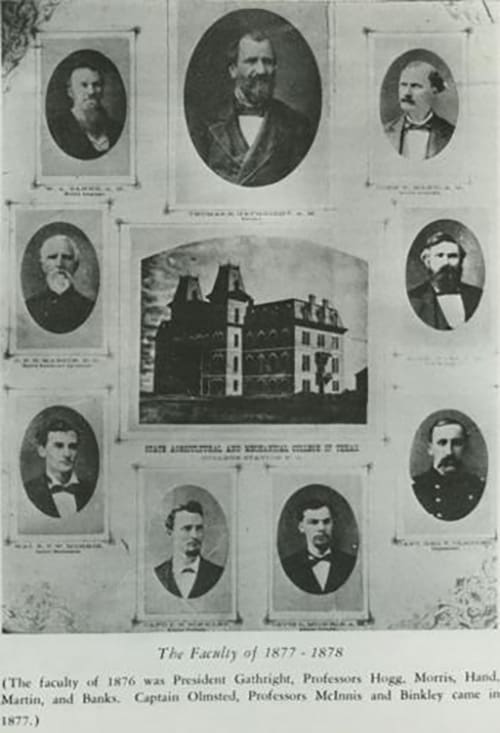
President Gathright and his additional seven professors. Captain Olmstead headed the Corps of Cadets.
There was one large building.
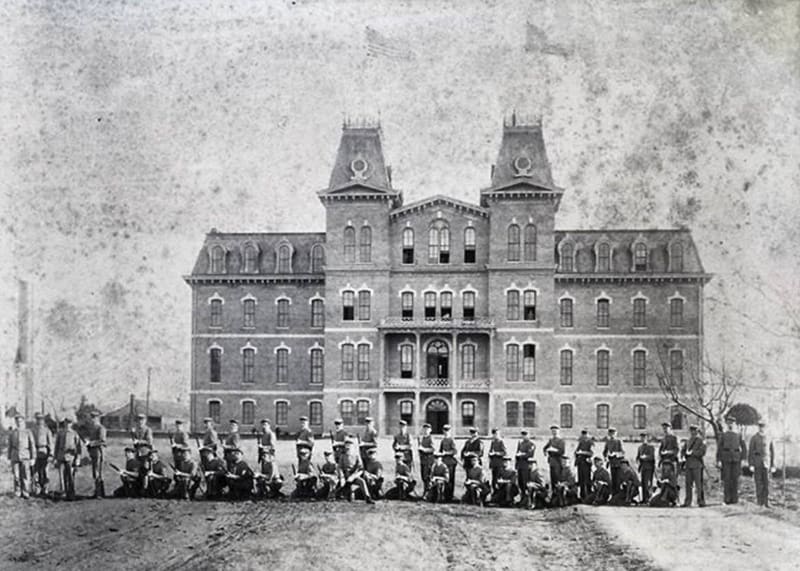
The original A&M building, "Old Main," constructed in 1875. It burned in 1912, and was replaced on the same site by the "Academic Building," now the oldest building on the campus. This photo is from 1894 with a company of cadets lined up.
A&M fielded its first football team in 1894.
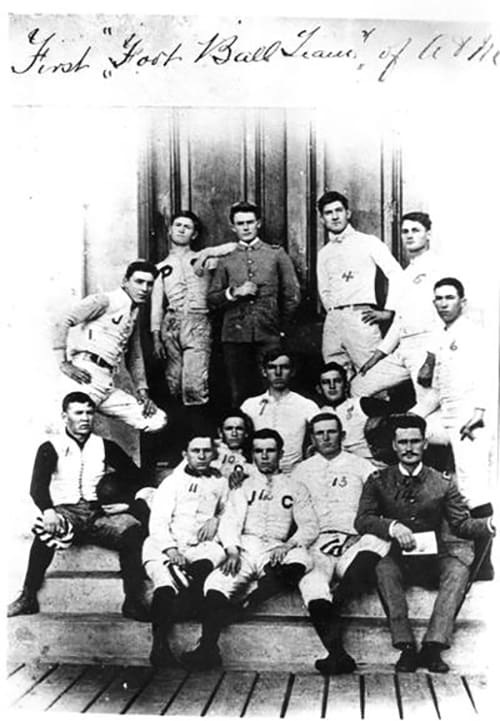
The first Aggie football team, 1894. It was coached by Dudley Perkins who also played fullback. The team beat Galveston Ball High School before losing to the University of Texas to finish at 1-1.
In 1914, A&M became one of the founding members of the newly formed Southwest Conference which included:
(1) University of Arkansas (2) Baylor University (3) University of Oklahoma (4) Oklahoma A&M (State ) (5) Rice (6) Southwestern University (7) University of Texas (8) Texas A&M
Since the founding of the conference, Texas A&M had a 48-8-3 record in the 7 seasons from 1915-21.
The problem was that the Aggies, despite the fact that they were playing excellent football and despite their sterling record, received little national recognition, playing primarily teams from Texas, and nearby Oklahoma and Louisiana.
It 1919, A&M played 10 games with 9 teams from Texas and only Oklahoma State being out of the "Lone Star State." In 1920, there were 6 Texas opponents and games with LSU and Oklahoma State. Thus far, before the Centre game, there were 5 Texas teams along with LSU, Oklahoma State, and Arizona, with only Arizona not being a border state.
This is why, while the Colonels had been traveling around the country, the Aggies found themselves isolated nearly 200 miles away from their campus at a vacant college whose students had left for Christmas vacation- The University of Dallas.
The University of Dallas? What and where was that? While the name would seem to have designated some big, municipal institution, the University only dated back to 1911 when the Vincentian Fathers had appropriated that name for what they had formerly called Holy Trinity College and Academy which they had founded in 1907.
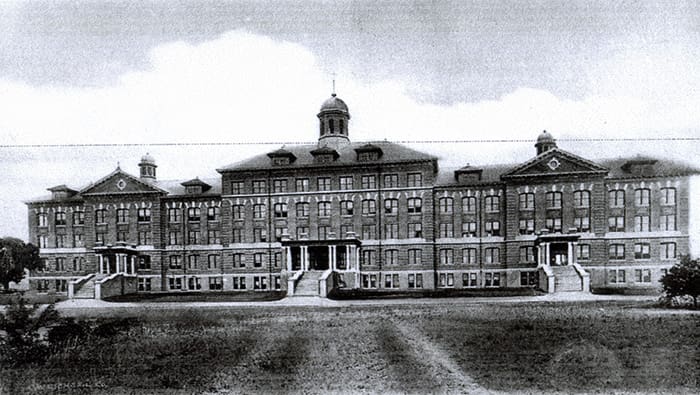
The University of Dallas where the Texas A&M Aggies "camped" in preparation for the game with Centre
Aggie coach, D.X. Bible, had brought his team to the rather isolated campus, vacated for Christmas vacation, so that they could concentrate on football. They had been holed up in the dormitory nearly 200 miles from College Station for several days while the Colonels were traveling. Their day began after breakfast with a 2-hour skull session and then exercise. After lunch and a period of rest, there was a 2-hour, full scrimmage session devoted to defense. Coach Bible had a good idea of what Centre's offensive schemes were like from talking to coaches around the country who had met Uncle Charlie's team on the gridiron.
In the modern era, teams obtain game films of their opponents, and scout other teams. For the Centre game, Bible contacted coaches, and it was part of the profession to extend the courtesy of cooperating if one were asked. After all, the coach providing help today may be the coach needing information tomorrow. Bible had provided insight to "Uncle Charlie" regarding the Arizona team which his Aggies had met earlier in the season.
Texas A&M kept up the 2-a-day routine through December 31, drilling, drilling and then drilling some more. There were no temptations. The team was virtually locked up in the Catholic seminary, and except for the Aggies attending the alumni-sponsored reception along with the Colonels during the evening of the 30th from which they also left early due to a curfew, it was-football, football, and more football.
Besides the fact that A&M was looking for respect by hopefully beating Centre, the upcoming game was tremendously important to Texas A&M for another reason.
The Aggie student newspaper, "The Battalion," had published a story which stated: The great respect that tradition has kept alive in the minds of Aggie athletes for Charlie Moran, because of his glorious work with athletes at the A&M college of Texas, will be to stimulate their stamina and provoke them to a superhuman use of their strength when they meet his Danville team of "Praying Colonels" at the Dallas Fair Stadium on January 2.
There is an actual love in the hearts of the Aggies for the man whom they know only as the unknown quality, responsible for a great achievement that was made in athletics at the college earlier in the twentieth century.
In the presence of Charlie Moran, supporters as well as players will be stirred to exert the greatest demonstration of Aggie spirit through the inherent force that was implanted by him many years ago, making them always do their best on the field of battle. It would be shameful to player and supporter alike to make a bad showing in the contest in Dallas, for we are all determined that his teachings were lasting.
This loyalty to the principles of Moran, and the desire to vindicate themselves before his eyes as true disciples of his teachings, will make the Aggies a dangerous opponent for the Praying Colonels.
( Uncle Charlie's overall record during his 6 years at A&M was 38-8-4. His winning percentage, to this day, excluding ties, is higher, at 82.6%, than any coach who has ever held the position more than 2 years. )
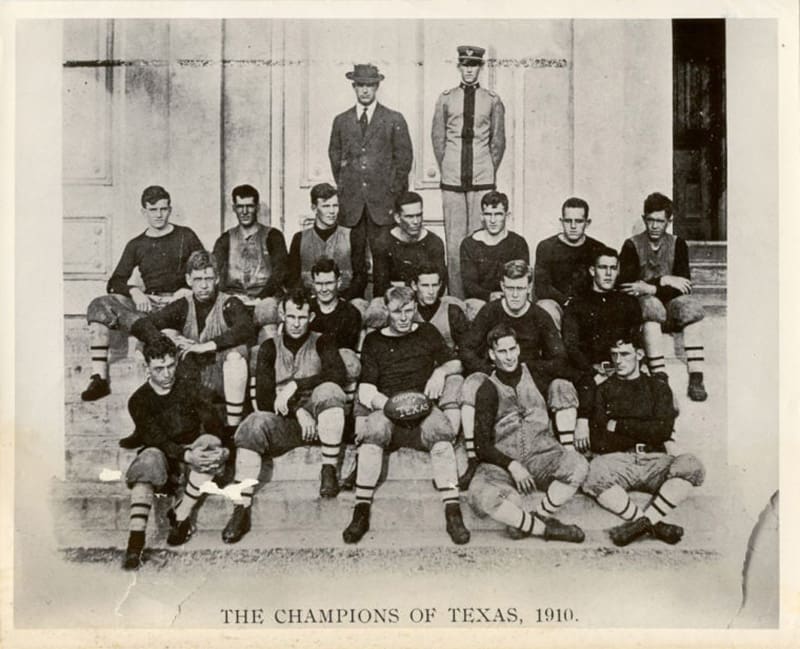
Uncle Charlie's 1910 team which was 8-1 with an important 14-8 win over Texas. The only loss was to Arkansas, 5-0, played in Fayetteville. Uncle Charlie at top with suit and hat.
Certainly, that was true. It was almost that Uncle Charlie was coaching against himself! He was so well respected and fondly remembered that it was imperative that A&M make the ultimate effort- to honor him!
It was, "We can't let Uncle Charlie down. We must beat him! Then he will know that we have absorbed and upheld his ideals and standards!"
Both teams spent New Year's Day resting. The Colonels had been kept up late by the revelers welcoming 1922 in at the Adolphus.
There was no such distraction out on the secluded University of Dallas campus.