
Howard Reynolds Comes to Danville
In the pre-radio world of the era, the only way to achieve national recognition was to grab the attention of major, metropolitan newspapers and syndicates like United Press, Associated Press, and Newspaper Enterprise Association. Centre’s rise to national prominence owed much to the sports editor of the Boston "Post," Howard G. Reynolds.
Reynolds joined the "Post" in 1899 when he was 20 years old and had become the sports editor by 1909.
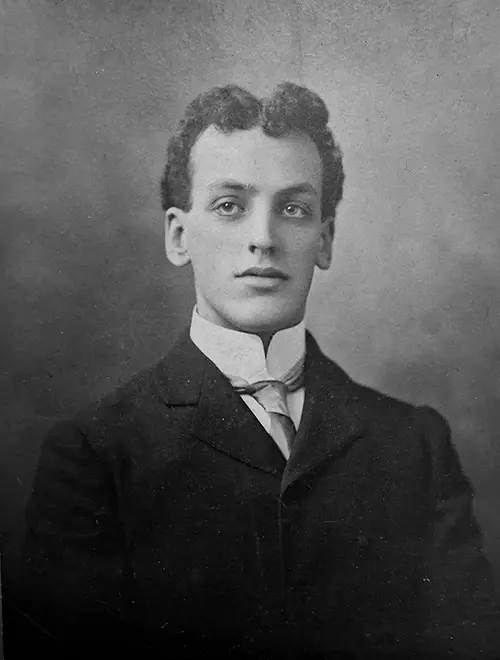
A young Howard Reynolds as he began his career with the Boston "Post."
For several years, Reynolds had taken an interest and a leading role in promoting the idea that colleges playing football should not claim "National Championships" when they only played teams in their own geographical area. In particular, he felt that the members of the "Big 3," Harvard, Princeton, and Yale, should schedule teams that were not just from the East. Of course, since he lived and worked in Boston, he had more contacts at Harvard, but as sports editor of the "Post," he was aware of what was going on with college football everywhere.
In the years beginning in 1900, members of the "Big 3" had been deemed "National Champions" in 12 of the last 17 seasons by various organizations. Yale and Princeton both made the claim in 1906 after ending 9-0-1, the tie being with each other.
"National Champions"
Yale Princeton Harvard
1900 1903 1901
1902 1906 (tie) 1908
1905 1911 1910
1906 (tie) 1912
1907 1913
1909
The eastern colleges claiming "National Championships" other than the "Big 3" were Pennsylvania ( 2), Pittsburgh ( 2 ), Penn State ( 2 ), Cornell, and Army.
In 1917 and 1918, he "Big 3" and most other colleges had their seasons either cancelled or shortened and declared "unofficial" due to the "Great War," as did many colleges, thus there were only 17 seasons from 1900.
Of the 11 teams making the claim, there were only 5 states represented; Connecticut, Massachusetts, Pennsylvania, New Jersey, and New York, all eastern states.
However, even though schools from the East claimed to be national champions every year, there were other noteworthy programs which felt they should receive consideration
The Michigan Wolverines were also a power during the era, and under Coach Fielding Yost, claimed to be the "National Champion" in 1901, 1902, 1903, and 1904.
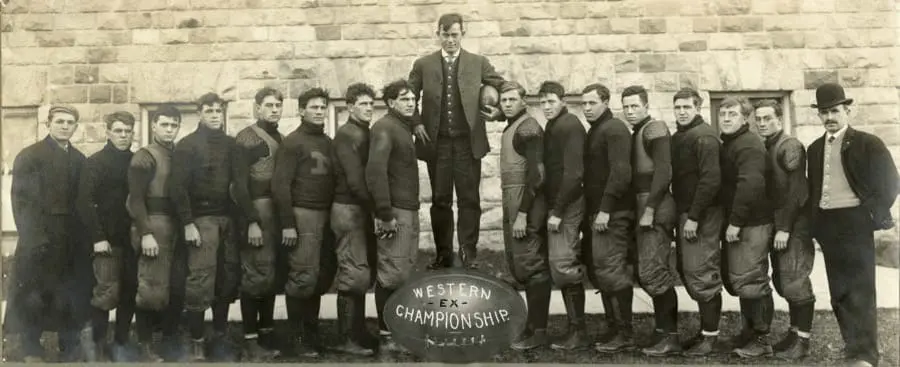
The University of Michigan somewhat humorously in 1905 added "EX" to the football on which Coach Fielding Yost poised. After claiming championships from 1901-04, the Wolverines were 12-0 in 1905, and 55-0-1 over the past 5 years, before their season-ending game with their arch-rival, the Chicago "Maroons." Chicago won the game, 2-0, and claimed the Western Conference title, thus the Michigan "EX." ( See Chicago below )
The University of Chicago Maroons, coached by Amos Alonzo Stagg, felt that they had the best team in the nation in 1905 after beating Michigan, 2-0.
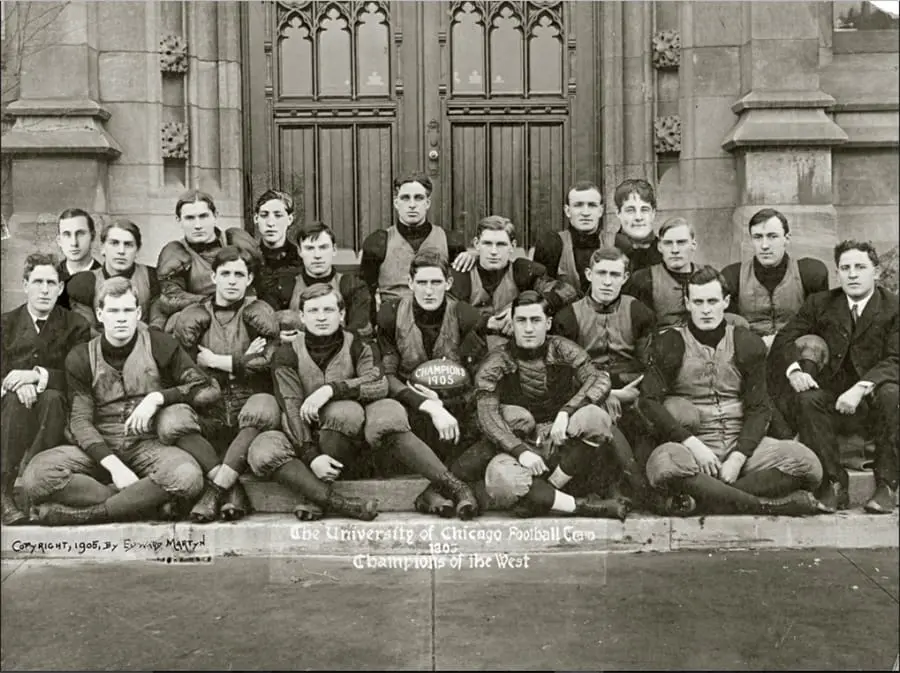
The University of Chicago "Maroons" were a major football power in the Coach Alonzo Stagg days. Stagg headed the program from 1892-1932 and is far right, first row. His 1905 team was 11-0, outscoring it opponents, 275-5. Chicago stopped playing varsity football in 1939 and dropped out of the "Big 10" in 1946. It now is a Division III school, playing in the Midwest Conference.
LSU claimed the top spot in 1908.
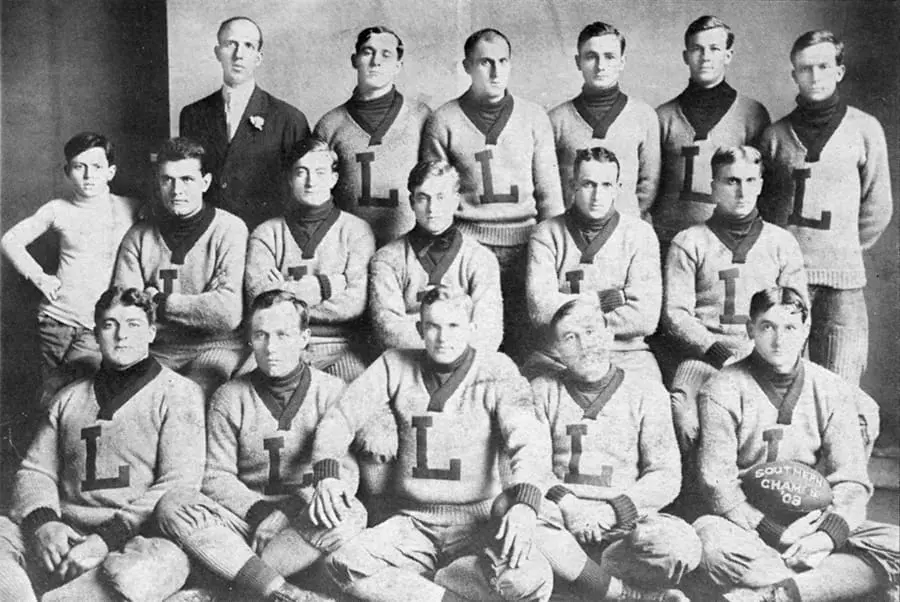
Louisiana State University was 10-0 in 1908, outscoring its opponents 442-11, and was the Southern Intercollegiate Athletic Association ( SIAA ) Champion. A notable win was an 89-0 thrashing over a decent 3-5 Baylor team. Edgar Wingard, top left, coached seven different teams during a career from 1903-25, stopping by LSU for only 2 years, 1907-08.
Georgia Tech had a great season in 1917 and felt it deserved the "National Championship" that year.
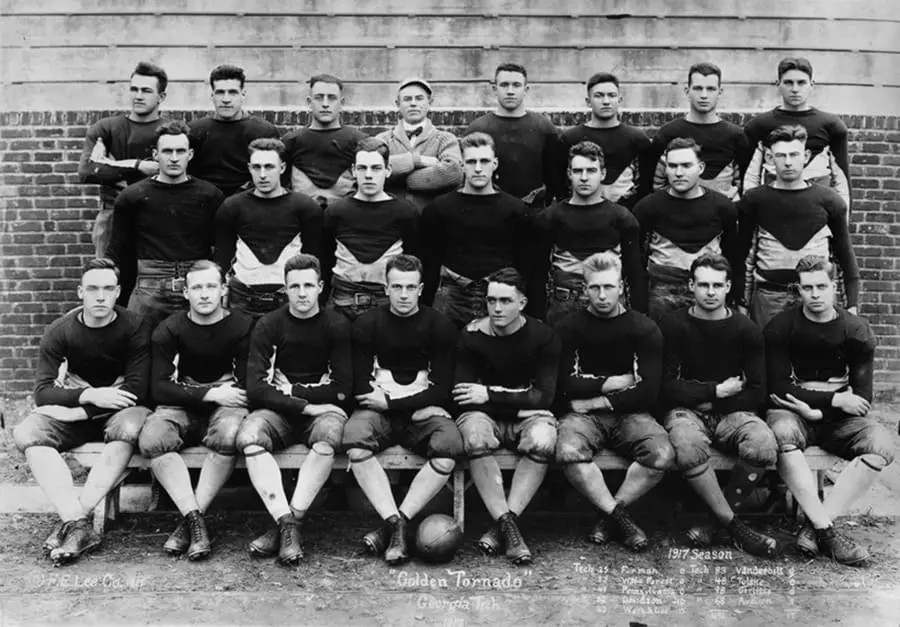
Georgia Tech was coached by the legendary John Heisman ( top row with cap and bow tie) for whom the "Heisman Trophy" is named. Heisman, in his 14th year at the helm, considered the 1917 "Golden Tornado" as his best ever team as it compiled a 9-0 record, rolling over its opponents, 491-17. Heisman was joined by many who considered Tech as the best Southern team for years. ( More about Heisman in Chapter 24. )
However, the situation was that there were no UNIVERSALLY accepted polls during the era to define the "National Champion" during the early 20th Century, even though it was accepted that the Eastern powers dominated the football landscape. This was the motivating reason that Howard Reynolds felt there should be a way to better define which college team should ultimately be designated as the true "National Champion."
Reynolds felt strongly that college football could only crown a truly valid "National Champion" if teams took on programs from all across the country and didn't play nearly all of their games at home.
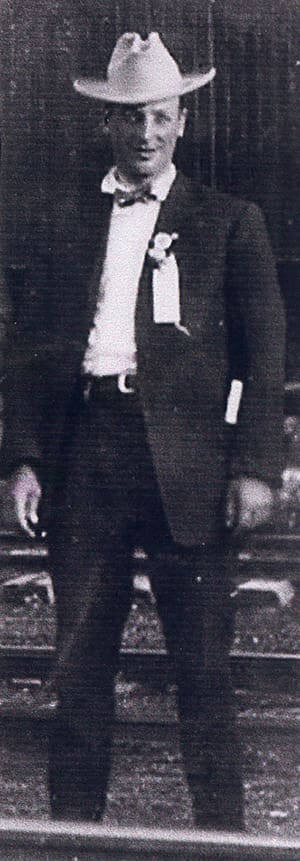
Howard G. Reynolds, sports editor of the Boston "Post"
He used the "Big 3" as examples.
From 1914-16, the "Big 3 " played 79 games, with 69 being at home and 10 away. Nine of the 10 games were in each other's stadiums.
"Away" Games "Big 3" 1914-16
Harvard
1914 Yale
1915 Princeton
1916 Yale
Yale
1914 Princeton
1915 Harvard
1916 Princeton
Princeton
1914 Harvard
1915 Yale
1916 Harvard
Holy Cross
Also, of the 79 games, there were only 10 games played against teams not from the East with only Virginia having won a game by beating Yale in 1915.
Non-East Teams Played by the "BIG 3"
(1) Virginia- 5
(2) North Carolina- 2
(3) Michigan- 1
Virginia Tech-1
Notre Dame-1
As the 1919 season began, Reynolds felt he needed a team from out in the "provinces" to play and hopefully beat one of the Eastern powers in order to prove that quality football was played in areas other than the East. He pointed out that if eastern schools understood the necessity of playing teams from outside of their immediate area before claiming to be the "National Champion," it would encourage more intersection games.
Reynolds became interested in Centre as the 1919 season progressed. He checked ticker-tape scores each week as they came in and began to pay attention to the Colonels, first when they beat Indiana, then trounced Virginia as badly as Harvard had.
He attended the West Virginia game at Princeton on November 1 as sports editor of the Boston "Post," and after watching the West Virginia literally destroy Princeton, he felt that he had probably watched the best team in the country in the Mountaineers.
At the same time, he continued to be intrigued by Centre. After he checked the ticker-tape reporting that Centre had gone to Charleston and beaten West Virginia the Saturday after he had watched the Mountaineers so outclass Princeton, Reynolds felt that he had found the vehicle which he could use to open the eyes of the Eastern powers that high quality football was being contested other than in the East.
Finally, Reynolds decided to act and talked Eddie Mahan, a three-time All-American halfback from Harvard during the 1913-15 seasons, who was felt by many to be the greatest player to ever suit up for the Crimson, to join him on a trip to Danville in order to check out Centre and attend its final, Thanksgiving game with Georgetown.
( I was the Executive Producer of a 2010 documentary called "The Wonder Team" about Centre's football teams after the "Great War," WW I. It was shown numerous times on the Kentucky Educational Television network ( KET ). We had Kent Stephens, the historian and archivist of the College Football Hall of Fame, on the program to discuss the Centre-Harvard games of 1920, 1921, and 1922. Stephens felt that the Centre-Harvard games were a decisive factor in college football expanding from basically a regional to national sport, and of course, Howard Reynolds was the principal catalyst in making that happen. )
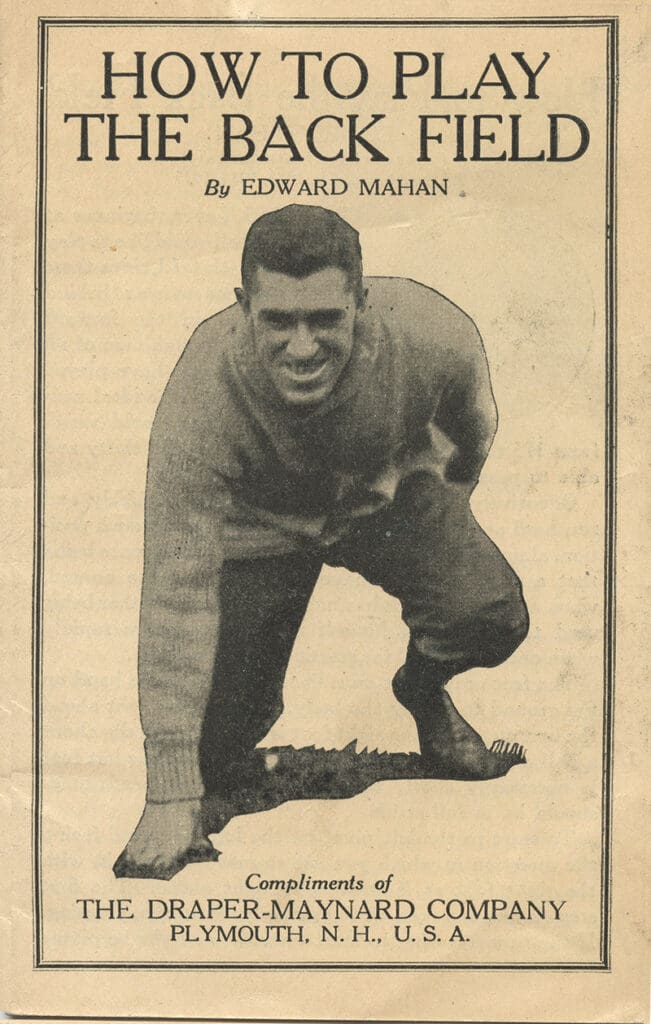
Harvard's All-American Edward "Eddie" Mahan, who became a great supporter of Centre and accompanied Howard Reynolds on his November 1919 trip to Danville
The Bostonians arrived on a Sunday night and after checking into the Gilcher Hotel, they decided to walk the few blocks to the Centre campus. There was a light on in the basement of the gym which attracted them, so they walked down the stairs where there was a man in the locker room hunched over a goose-neck lamp and asked if he knew where Coach Moran may be.
“You’re looking at him,” Uncle Charlie replied. Reynolds and Mahan introduced themselves and asked what he was doing. “Repairing my boys’ equipment. Our next game may be played in the mud. Georgetown’s field doesn’t have a speck of grass. We may need these mud cleats if it rains.”
Moran could tell by the looks on their faces that the visitors were incredulous. “This isn’t Harvard gentlemen. Down here, we do what we have to do to get along.”
The meeting in the basement later made it into the story that Reynolds filed for his story in the "Post." The next day the Bostonians met with Dr. Ganfield to personally check out the rumors that had been coming out of West Virginia that Centre had cheated in order to win the game in Charleston against the Mountaineers.
Mahan was especially interested in making certain that his alma mater would never even consider the possibility of scheduling a college which cheated. After meeting with Dr. Ganfield, he was totally convinced that Centre had an honorable program and later reported such to the Harvard administration.
The next few days, the two Bostonians met with the players and watched practices. They later were quoted as saying, “These guys are for real. They well may be the greatest collection of football players in the country.”
Mahan spent considerable time with Bo. It was star with star. “You’ve been receiving a lot of press in the East. Are you aware of this?” Bo said he was, but, “I wish they’d write about the team, not just me.”
It was about the team. It was always the team.
On Thursday, Thanksgiving, everyone traveled on the Southern Railroad north from Danville through Lexington to Georgetown, a 50-mile ride. Some of the Colonels' fans had felt Centre should drop Georgetown from its schedule after the drubbing that the Tigers took in 1918, being slaughtered, 83-3. They felt a stronger opponent with more clout would be better suited to the greater aspirations of the program.
Dr. Ganfield disagreed.
“It wouldn’t be the gentlemanly thing not to play Georgetown. We have played for years. Sometimes, we are stronger. Sometimes, they are. Perhaps, someone may suggest in a few years that Georgetown not play us if they are in the ascendency. We must remember that we have a long and friendly rivalry, based on the respect that we have for each other.”
Howard Reynolds and Eddie Mahan watched a track-meet type of game as Centre led 21-0 as the first quarter ended, 42-0 at the half, 63-7 after the third period, and 77-7 as the officials shortened the game by 5 minutes and blew the whistle during the final quarter.
Georgetown did manage to score, but it was only because of a mix-up on a center pass back from Red Weaver. The Centre backs were running a play where there was motion right and Red centered left. A Tiger lineman named James Moss picked up the loose ball and lumbered into the end zone unmolested for a score.
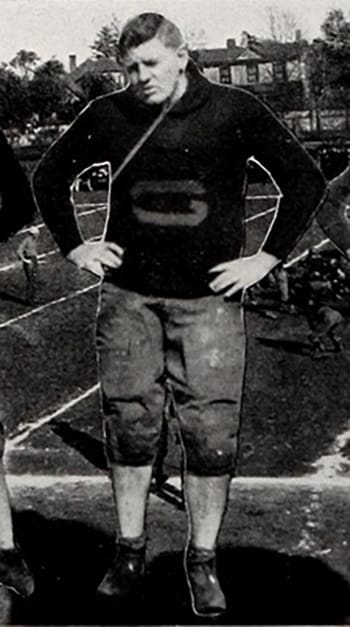
James L. Moss, Georgetown tackle, who picked up a misdirected Red Weaver center pass and scored one of the two touchdowns which Centre gave up during the 1919 season.
Red Weaver was 11 for 11 during the game and ended with 46 straight extra points after his last kick.
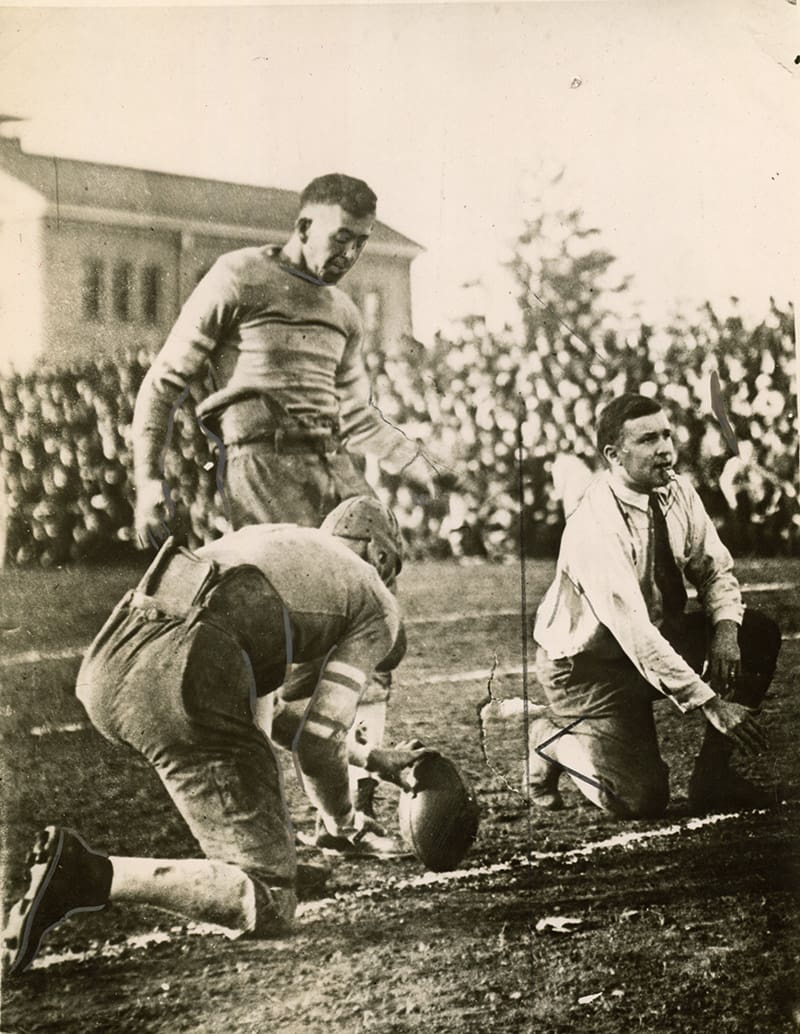
Press photo of Red Weaver kicking his 46th extra point to end the 1919 season with Bo holding
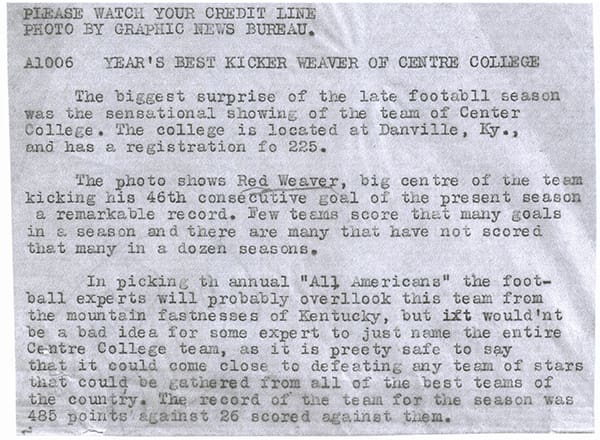
Laudatory caption on back of photo about Weaver's kick in Georgetown. Note the use of "Center College" and Weaver's position as being a "centre." The caption has the correct number of points, 485, scored by the Colonels during the 1919 season but is incorrect about the 26 points given up. The total was actually 23. Diane Johnson, Director of Strategic Planning and Communications at Centre and respected historian of the college, discovered the actual shoe that Red Weaver used during his career, which included a consecutive record of extra points kicked which stands to this day, and has featured it in a display of Centre's memorabilia. ( More in Chapter 31 )
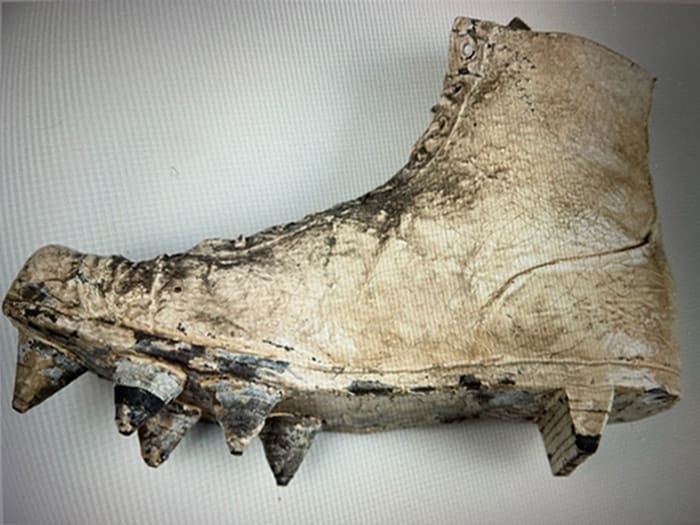
Red Weaver's flat-toed shoe
Bo could have led the nation in scoring in 1919 if he’d had any aspiration to achieve that honor. He ended with 122 points while “Rodg” Rodgers of West Virginia tallied 146.
Going into the DePauw game, Bo trailed Rodgers by just 2 points. However, he handed the ball to Red Roberts twice during that game for easy scores rather than taking it in himself. Also, during the final game with Georgetown, he made sure that three seniors, Allen Davis, Howard Van Antwerp, and Matty Bell, each scored during their last game.
Again, it was all about the team. It was always the team.
Centre was easily the highest scoring team in the country in 1919. The Colonels put 485 points on the board in 535 minutes, remembering the 5 minutes taken off the clock at Georgetown, and were dubbed the “Point-a- Minute Colonels” by the press.

West Virginia finished at 8-2 and scored 326 points to end up a distant second as the most prolific offense.
As impressive as the Colonels’ offense had been, the defense of the Gold and White was even more amazing. Their opponents scored a grand total of 23 points during the 9 games, and the only points which were totally the responsibility of the defense were the 6 points scored by West Virginia during the early minutes of Centre’s 14-6 win in Charleston.
Indiana got a field goal after the Hoosiers had blocked a punt which they had recovered on the Colonels’ 25 and had to settle for 3 points because they couldn’t advance the ball any closer to the goal after 3 unsuccessful runs. Virginia scored after a shanked punt and 2 penalties had given the Wahoos possession on Centre’s 10. Even then, it took 4 plays in order for the Colonels’ goal to be crossed. And, Georgetown scored on the mix-up during a center toss when the free ball was picked up by a lineman.
Three touchdowns, 2 extra points, and 1 field goal. That was the total amount of scoring against Centre in 1919.
On Friday, after the Georgetown game, Howard Reynolds and Eddie Mahan boarded the train for the long journey from Danville back to Boston. Reynolds wanted his readers to have a feeling for what was going on in the world of college football outside of their own area as he typed away during the trip.
Mahan not only wanted the "Post" readers to be able to read about his impression of Centre and its team in an article he was preparing on the train, but he was going back to Boston with the mission of reporting back to officials at Harvard about how strongly he felt that Centre should be put in a slot on the Crimson schedule for the upcoming, 1920 season.
Centre’s people felt that everything had gone perfectly during the Bostonians’ visit. They felt that there was a real possibility of Chief Myers’ long-held goal of meeting one of the “Big 3” on the gridiron becoming reality.
Now, all that they could do is wait.
Wait, not only if the Colonels as a team would be heading east for a game during the upcoming season. but whether there would be individual, national recognition for any of the players who'd had such great seasons during the most successful of all of the campaigns since Centre's first game some 40 years previously.
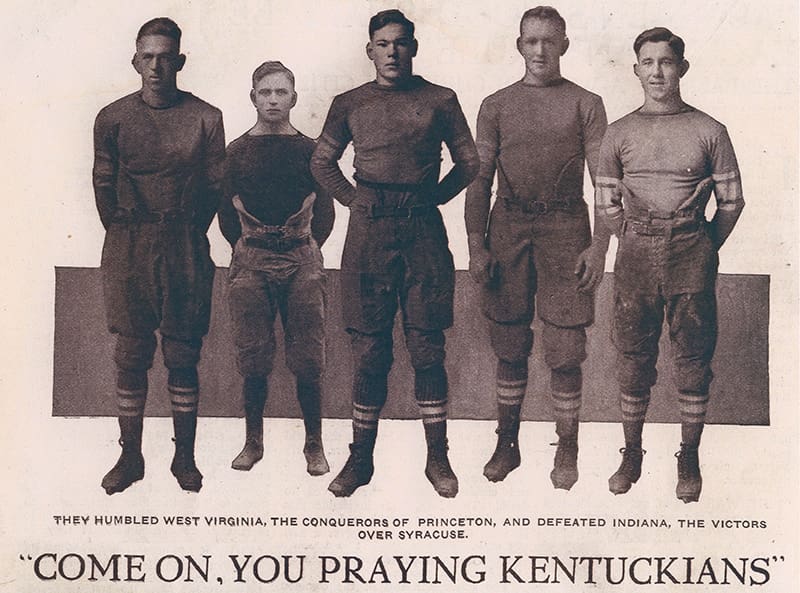
Individuals who Centre hoped would receive national recognition after the 1919 season. Left to right- Red Weaver, Chick Murphy, Sully Montgomery, Red Roberts and Bo McMillin